Weaving journeys - an essay by Zara Stanhope
Zara Stanhope recently visited the exhibition currently in place in the Whakaari gallery at Te Atamira and wrote a poignant reflection of the work she found within. The exhibition will be in place and is free to visit until 30 January 2026.
To be standing in this exhibition Notes in the Border, Notes at the River, Notes from the Ocean is to be feeling the lapping of tides of creative relationships across the vast Te Moana nui-a Kiwa.
Scrolls as pou on one side of the gallery face sculptural and visual imagery in a constellation of works that resemble creative waves that have surfaced across the distances between Alys Longley, Francisco González Castro, Macarena Campbell-Parra and Máximo Corvalán-Pincheira. Unlike the South Pacific Gyre, which rotates in an easterly direction from Aotearoa to Patagonia and up the Chilean coast to return westward across the equator, these personal currents cross in all directions, whirlpooling into eddies of creative outputs that are responsive to the particular contexts of the artists’ collaborations.
Earlier works suggest that the artists have, even if invertedly, framed their time being together as opportunities to share ways to engage others. Documentation of the durational Proyecto Cartón /Cardboard Project suggests a pedagogical chart as a tool for potential learning activities. The spooling collection of notes and instructions is a ‘score’ or collection of prompts and pictograms for action, both a record of engagements and guide for action.
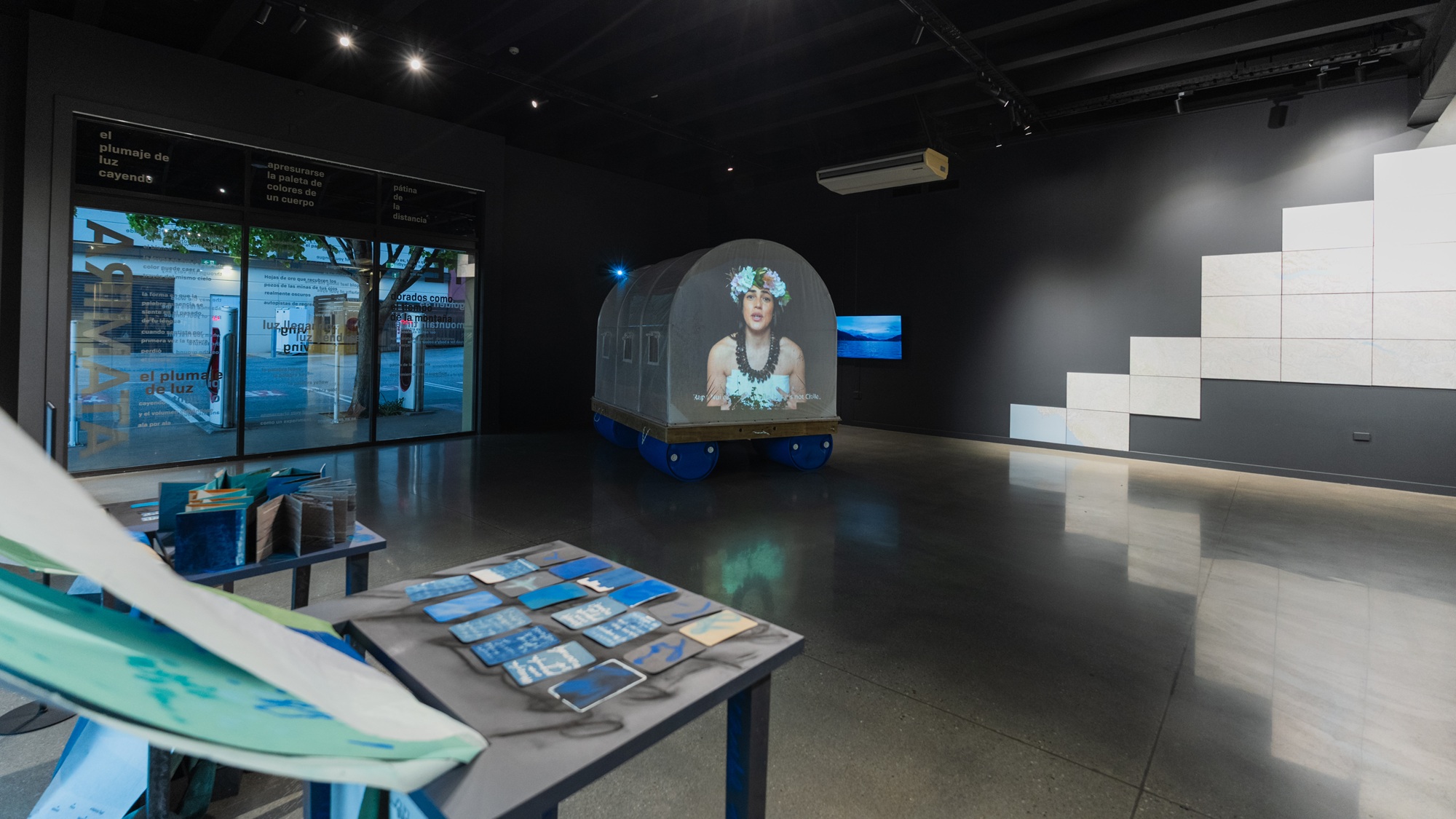
As a predecessor to books, the scroll is an important centuries-old literary medium for sharing knowledge, including political and religious texts, and a form of pictorial story-telling. Longley utilises giant drops of paper and pianola rolls as the scenography for reflections and questions that arise from the friends cross-cultural conversations. These create the environment for notes that reflect the efforts of acquiring new languages, the bi-lingual reflections noted on washed blue cards as if translation is a game of chance to the artist book with its questioning of whether it is possible to re-route the biases ingrained into our cultures, DNA and mind? While questioning how we immerse ourselves in the deep oceans of others’ worlds Longley’s works call for recognising the diversity of ways to gain cultural understanding – sensory and performative as much as linguistic.
Te Atamira has generously supported the artists’ exchanges on the ground and in the gallery space. Longley is the conduit for sharing their thoughts onto the windows, to act as portals for world-making. The texts reflect the role of these apertures to frame the view outside to the horizon and to bring light. The phrases in Spanish and English such as ‘because the magnetism of connection’ or ‘because I am the coastline and you are the sea’ poetically express the force of their desires to bond across the immensity of distance and pressures of life.
Máximo Corvalán-Pincheira’s work Isla activates the touch of bodies that we read elsewhere in the exhibition. The shape of distance is given characterised by the raft, a means of carriage and movement on water that Corvalán-Pincheira has used in previous works in Chile to convey the hydrocene or the politics of water. Floating on Lake Whakatipu carrying plants that can be found in both Aotearoa and Rapa Nui (an island which shares cultural and linguistic ties with tangata whenua), the raft Isla becomes an archipelagic symbol of ecological kinship. More than this, the ghostly offerings of the figures projected inside suggest the raft as a metaphor for a way of thinking about the significance of the fluidity of histories, diversity and interconnected relations across the Pacific. With echoes of Édouard Glissant’s arguments for a poetics of relations, Corvalán-Pincheira’s raft also urges a shared need to care for a global ecology in crisis.
Notes in the border, Notes at the River, Notes from the Ocean deliberately unravels and makes precarious expectations of relations across Aotearoa and South America, aesthetically privileging the media that are fluid or friable in their affect in works of such a scale that we can only gain a partial view of the whole. They disrupt a singular perspective, like Corvalán-Pincheira’s unsettles our faith in maps. The artists interventions flow across topography and more culminating in their collaboration in virtual space A Tilting Body of Precarious Maps & Migrant Constellations, which like all their works is part of an ongoing process of interrogation and celebration of being in the flows of relations that can’t easily be put into words.